


The Eucharist first arrived on Australian shores more than two hundred years ago. Throughout our country’s history, there are amazing stories of people being transformed by Jesus’ eucharistic presence in their lives. The Eucharist in Australia series will share these inspiring stories.
During an address at St Peter’s Square in 2026, Pope Leo XIV described the Eucharist as “indispensable for Christian life.”
“It is through the Eucharist that even our hands become ‘hands of the Risen One,’ witnesses of his presence, of his mercy, and of his peace,” the Holy Father said.
Australia’s earliest Catholics found the Eucharist indispensable from their lives during a time where celebrating the Eucharist was seriously challenged.
In the early 1800s, the Catholic population of colonial Australia, made up of predominantly Irish settlers and convicts, found solace and comfort in the Eucharist, where Jesus was truly present to them amidst the challenges of life in the colony.
They rejoiced in 1800 when emancipated convict Father James Dixon arrived in Australia and began celebrated the sacraments in secret, for the celebration of the Mass was illegal. A few years later, the British colonial government finally authorised this celebration of the Mass, and the first permitted celebration took place on May 15, 1803.
During an escape of Irish Catholic convicts at the Castle Hill Rebellion, Fr Dixon was called in by authorities to help quell the rebellion. Despite lending a hand to the authorities and seeking peace, Fr Dixon had his permission to celebrate the Mass swiftly withdrawn, and he had to return to covert ministry before leaving Australia in 1809.
Without a priest in the country, the Catholic community were left without the sacraments, and repeatedly petitioned the authorities to allow a new priest to join them. The lay faithful kept the flame of faith alive in these challenging years, until the arrival of Father Jeremiah Flynn in 1817, who began performing underground ministries for the community.
Before long, Father Flynn was also found out by authorities, who deported him from Australia.
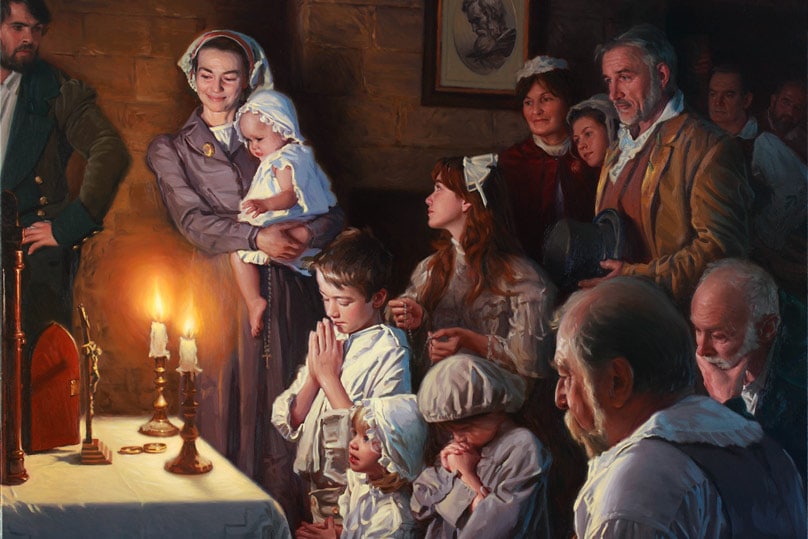
Through this series of setbacks, the early Australian Catholic Church was sustained by a comforting beacon of hope: Jesus’ presence in the Blessed Sacrament. For as he was being deported, Father Flynn left a consecrated host behind to be cared for by the faithful, who would gather in homes around the Rocks to adore Jesus.
They could not celebrate Mass, but they could find comfort in Jesus’ presence, worshipping and praying in the stillness before He who is truly present in the Eucharist.
The Blessed Sacrament sustained Australia’s first Catholics. All were equal before Him, something that many found hard to understand. British Protestant authorities were shocked when visiting French Catholic sailors and officers would join their Irish Australian counterparts on their knees in adoration. All worshipped Him in the same manner, no matter their social standing.
These early generations of the faithful kept the flame of faith alive through their Eucharistic devotion to this life-giving Blessed Sacrament. Just as Pope Leo XIV proclaimed, the Eucharist was essential to their lives.